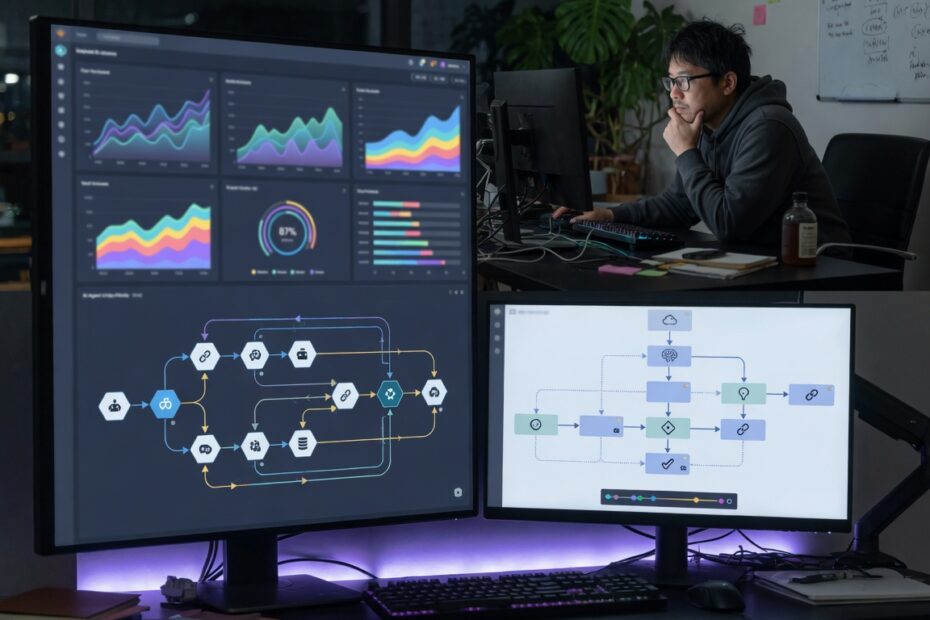
The last week of AI news didn’t bring a bigger model. It brought better plumbing. Mistral pushed Workflows into public preview inside Studio, Anthropic opened a signed MCP server registry, and a production RAG study quietly confirmed that rerankers now outperform model upgrades for retrieval quality. None of these are headline-grabbing in isolation. Together, they describe a maturing discipline: LLM application engineering is shifting from prompt experimentation to production AI patterns that look a lot like traditional distributed systems engineering, just with a language model in the loop.
If you build or consult on AI systems for a living, this is the signal to pay attention to. The vendors are no longer selling you a smarter brain. They’re selling you the nervous system around it.
Orchestration Is the New Battleground, Not Model Quality
Mistral’s Workflows feature adds stateful execution, fault tolerance, and observability to multi-step AI processes directly inside Studio. That’s a direct answer to the single biggest pain point in deploying AI agents beyond a demo: what happens when step four of a seven-step pipeline fails, times out, or returns malformed output? Until recently, most teams duct-taped this together with custom retry logic, LangGraph checkpoints, or homegrown state machines.
Microsoft’s Build 2026 messaging reinforces the same shift at platform scale, putting agents at the center of its product strategy rather than treating them as an add-on to Copilot. The pattern across both announcements is consistent: AI agents are being redesigned as always-on, multi-step systems with persistent memory and execution guarantees, not one-shot prompt-response loops.
- Stateful execution lets workflows resume after partial failure instead of restarting from scratch.
- Observability tooling exposes step-by-step traces, which is essential for debugging agent behavior in production.
- Fault tolerance reduces the operational burden on engineering teams running agents at scale.
For freelance automation consultants and internal platform teams alike, this means the build-vs-buy calculus around orchestration layers is changing fast. Rolling your own state machine on top of a raw model API is increasingly a maintenance liability rather than a differentiator.
RAG Systems: Retrieval Tuning Beats Model-Chasing
A production study cited this week found that adding or upgrading a reranker delivered more measurable quality improvement in RAG systems than swapping the underlying base model. This should reshape how teams prioritize their optimization backlog. Chasing the latest frontier model release is expensive, disruptive to prompts and evals, and often yields marginal gains on real retrieval-heavy tasks.
Reranking, by contrast, directly attacks the part of the pipeline that usually breaks first: relevance of retrieved context before generation even happens. This lines up with a broader trend toward visual RAG builders and retrieval-specific tooling rather than treating retrieval as a solved commodity layer bolted onto any model API.
- Reranker upgrades are cheaper to test and roll back than full model migrations.
- Retrieval quality issues compound downstream, so fixing them earlier in the pipeline has outsized ROI.
- This trend favors modular RAG architectures where retrieval, reranking, and generation can be swapped independently.
Practically, this means teams evaluating model APIs should stop treating “which LLM” as the primary lever and start treating retrieval infrastructure as a first-class engineering surface with its own eval suite.
Standardization Around Tooling and Consolidation of Surfaces
Anthropic’s new MCP server registry, with signed packages, addresses a real friction point: verifying and managing tool integrations for agents without ad hoc trust decisions on every connector. As agent ecosystems grow, signed and discoverable tool registries function similarly to package managers in traditional software, reducing integration risk and speeding up secure deployment.
Meanwhile, OpenAI’s decision to retire the standalone Sora web app and sunset its API by September, folding video generation into ChatGPT instead, points to a parallel consolidation trend. Vendors are narrowing the number of surfaces users and developers need to touch, betting that a unified assistant interface beats a sprawl of specialized apps and endpoints.
Implications for Builders and Consultants
Put together, these developments sketch a clear trajectory for anyone doing serious LLM application engineering in 2026:
- Orchestration and state management are becoming platform features, not custom code you write yourself.
- Retrieval tuning and reranking deserve as much attention as model selection, if not more.
- Tool trust and integration security are being standardized through signed registries rather than left to each team’s discretion.
- Product surfaces are consolidating, which affects how you plan API dependencies and roadmap risk for client work.
Key Takeaway
The industry is quietly professionalizing. The winners over the next year won’t be the teams with access to the newest model, but the ones who invest in production AI patterns: durable orchestration, disciplined retrieval evaluation, and trustworthy tool integration. For freelance builders and automation consultants, that’s good news: it rewards engineering rigor over API-chasing, and that’s a skill set that compounds.