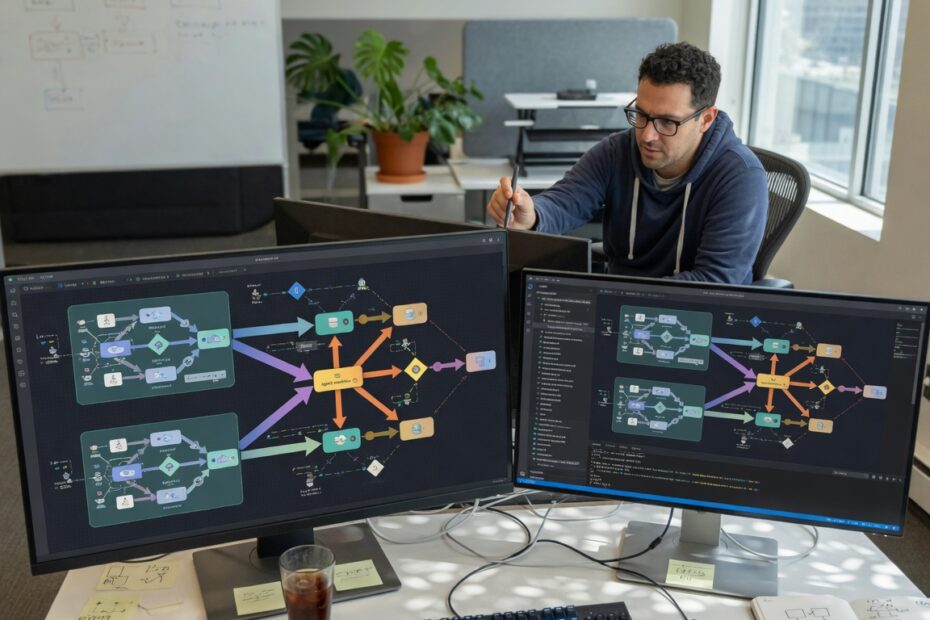
The AI engineering conversation has quietly shifted. A year ago, most teams were asking whether retrieval-augmented generation could work at all. Today, the question is how to operationalize it at scale — with governance, tool orchestration, and measurable reliability. SnapLogic’s September 2026 release, which adds native Amazon Bedrock Managed Knowledge Base ingestion, semantic retrieval, and multi-step agentic retrieval flows, is a useful signal of where the industry actually stands. This isn’t a demo feature. It’s infrastructure for production AI patterns that enterprises can audit, monitor, and scale.
From Chatbot Demos to Agentic RAG Pipelines
The defining trend of this release cycle is the maturation of RAG systems from a simple retrieve-then-generate loop into something closer to a reasoning pipeline. SnapLogic’s addition of hundreds of prebuilt agent-tool pipeline patterns reflects a broader market consensus: single-shot retrieval is no longer enough for enterprise use cases involving multi-source data, compliance constraints, and multi-step decision-making.
Agentic RAG introduces intermediate reasoning steps — query decomposition, tool selection, retrieval re-ranking, and self-correction — before a final answer is generated. This matters for anyone building AI agents that need to pull from structured databases, unstructured documents, and live APIs in the same workflow. The practical implication is that retrieval is no longer a bolt-on feature; it’s becoming a first-class architectural layer, complete with its own evaluation benchmarks. Recent research on first-stage retrieval benchmarks for agentic RAG confirms this: teams now measure retrieval quality independently of generation quality, treating it as a distinct engineering discipline rather than an afterthought.
Context Engineering Is the New Prompt Engineering
If 2023-2024 was about prompt engineering, the current cycle is about context engineering — deciding what information, tools, and memory state an LLM sees at inference time, and why. Training material and vendor documentation increasingly emphasize tool calling, the Model Context Protocol (MCP), memory management, and evaluation as the core building blocks of reliable systems, rather than clever prompting tricks.
This shift has real consequences for how teams staff and structure AI projects. Consider:
- Model APIs are becoming commoditized — the differentiation now lives in orchestration, retrieval quality, and context assembly, not in which foundation model you call.
- MCP-style protocols are standardizing how agents discover and invoke external tools, reducing the custom glue code that used to dominate agent projects.
- Evaluation pipelines — not just accuracy metrics but latency, cost, and hallucination rate under load — are now expected deliverables, not optional extras.
This is also why “LLM application engineer” has emerged as a distinct job title in the tech labor market. It’s a role focused squarely on building with foundation models — integrating retrieval, memory, and tool use into working products — rather than training or fine-tuning models from scratch. For freelancers and consultants in this space, that distinction is commercially important: clients are hiring for integration and reliability expertise, not research capability.
What This Means for Builders and Operators
For teams shipping real products, three implications stand out. First, hybrid retrieval — combining vector search with keyword and semantic search — is now the practical default rather than a nice-to-have, because pure vector similarity search consistently underperforms on precision-sensitive enterprise queries. Second, platform vendors packaging agentic RAG as prebuilt pipelines (as SnapLogic has done) lowers the barrier to entry, but it also means competitive advantage shifts toward how well you customize and evaluate these patterns for your specific domain data, not whether you can build them from scratch. Third, orchestration and observability tooling — logging every retrieval step, tool call, and agent decision — is becoming a baseline requirement for any team deploying agents in regulated or high-stakes environments.
For independent consultants and small engineering teams, this is an opening. Enterprises are actively looking for practitioners who understand context engineering, MCP-based tool integration, and retrieval evaluation — skills that sit above simple API wrapping but below full model training. That gap is exactly where freelance AI engineering work is concentrating right now.
Key Takeaway
The move toward agentic RAG, standardized tool protocols, and dedicated evaluation practices marks the end of the AI demo era. Production-grade systems now require deliberate context engineering, hybrid retrieval strategies, and continuous evaluation — skills that define the emerging LLM application engineer role. Builders who master this operational layer, rather than just calling a model API, will be the ones capturing value in the next phase of enterprise AI adoption.