The AI infrastructure landscape just got a meaningful upgrade for builders who care about where their data lives and how their models behave in production. Mistral’s public API preview of Large 4, with open weights promised later this month and European-region deployment under European law, lands at the same moment Cloudflare, Progress Software, and a cluster of EU-hosted gateways are shipping tools aimed squarely at production AI patterns. Taken together, these releases sketch a clearer picture of what serious LLM application engineering looks like heading into next year: fewer open-ended chat demos, more bounded, auditable, retrieval-grounded systems.
European Model APIs Are No Longer an Afterthought
Mistral Large 4’s rollout is notable less for raw benchmark positioning and more for its governance posture. A model API preview backed by onshore European hosting addresses a real procurement blocker for regulated industries: legal teams asking “where does the inference happen, and under whose jurisdiction?” Mistral isn’t alone here. Opper AI now offers an EU-hosted gateway spanning more than 700 models, and GreenPT is available through that same gateway, giving engineering teams a GDPR-aware routing layer instead of a single-vendor dependency.
For freelance consultants and in-house platform teams building client-facing systems, this matters practically. A unified gateway that can route between European and US-hosted model APIs based on data residency rules turns a compliance headache into a configuration decision. Expect procurement conversations in 2025 to increasingly ask not “which model is smartest” but “which model can we legally deploy for this specific workload, in this specific region.”
Agentic RAG Is Replacing Static Retrieval
The second major thread this cycle is the consolidation of RAG systems into something more dynamic. Cloudflare’s move of AI Search into general availability, paired with its Web Search API entering open beta, gives teams a managed retrieval layer that covers site search, document indexing, and agentic patterns without standing up a separate vector database and orchestration stack from scratch.
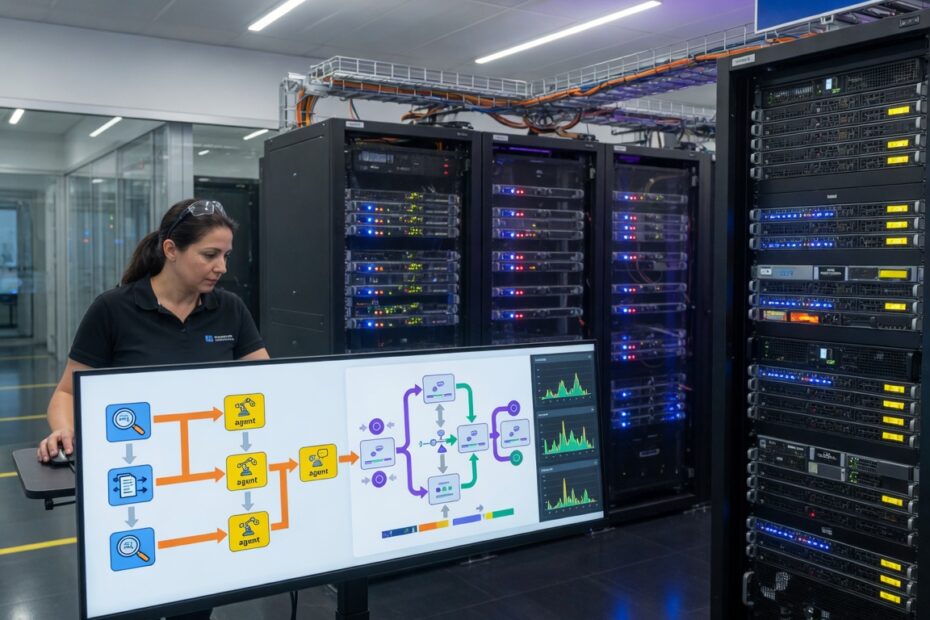
Progress Software’s Smart Agent additions push the same direction further: agentic RAG with MCP (Model Context Protocol) support and live access to business systems and web sources. This is the real shift worth tracking — retrieval is no longer a one-shot “fetch context, stuff the prompt” operation. It’s becoming a loop where AI agents decide when to query, which tool to call, and whether the retrieved context is sufficient before responding. That loop is exactly where most production failures currently happen: stale indexes, irrelevant chunks, and agents that call tools they shouldn’t.
- Static RAG: embed once, retrieve top-k, generate — fast but brittle against live data.
- Agentic RAG: the model decides whether to search, which source to hit, and how to validate results before answering.
- MCP-based tool access: standardizes how agents reach business systems, reducing custom integration glue per client project.
For builders, this means the RAG pipeline is now a first-class engineering surface, not a side utility. Contextual embeddings and enterprise-search-focused model updates are maturing in parallel, which should reduce the retrieval-quality tax that’s historically made agentic systems unreliable in production.
Bounded Decisions Over Open-Ended Chat
The most quietly important trend here is the emergence of narrow, bounded-choice APIs — exemplified by OpenAI-adjacent startup activity around a “Decisions API” plus background agent and workflow execution. This reflects something practitioners have been saying for a while: open-ended chat is a poor primitive for production systems. Constrained actions — pick one of N options, execute a defined workflow, run a background job with a clear success condition — are dramatically easier to test, monitor, and roll back than free-form generation.
This is the harness-engineering layer of production AI patterns: tool contracts with explicit schemas, decision boundaries that limit blast radius, and background execution models that decouple latency-sensitive user interactions from longer-running agent work. It’s less glamorous than a chatbot demo, but it’s what actually survives contact with real users and real failure modes.
Implications for Builders and Consultants
If you’re architecting client systems today, three things follow from this news cycle. First, data residency is now a routing problem solvable at the gateway layer, not a reason to avoid EU clients. Second, your RAG pipeline deserves the same engineering rigor as your core application logic — agentic retrieval with tool access needs monitoring, not just a cron job that re-embeds documents weekly. Third, favor bounded decision primitives over chat wrappers whenever the task allows it; they’re cheaper to debug and easier to sell to risk-averse stakeholders.
Key takeaway: The AI engineering stack is maturing around governance, grounded retrieval, and constrained action — and builders who adopt EU-aware model APIs, agentic RAG, and bounded-decision patterns now will ship more defensible production systems than those still betting everything on open-ended chat.