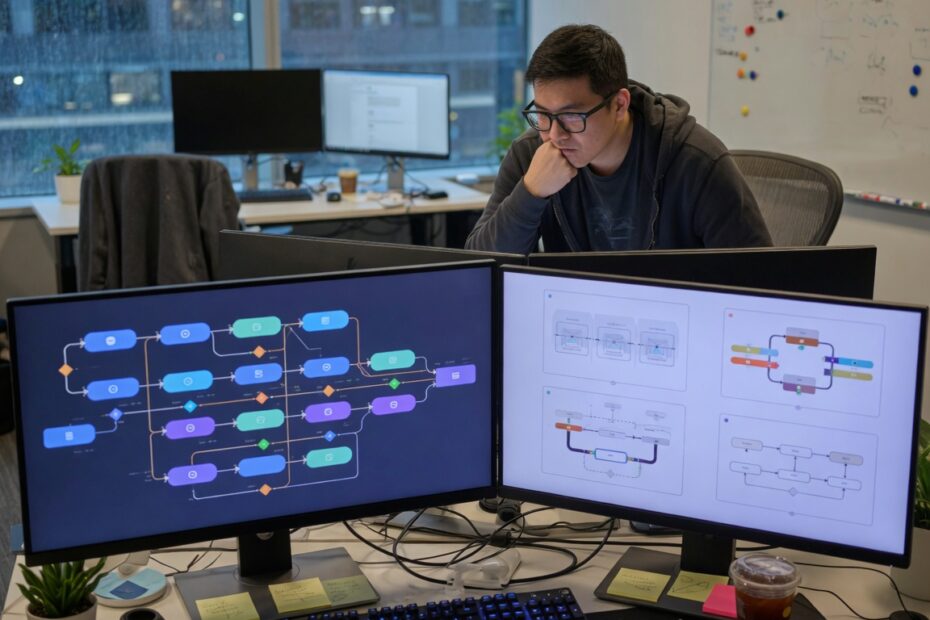
The AI agent stack is consolidating fast, and this week’s biggest signal is OpenAI moving its Agents API into public beta. For anyone doing serious LLM application engineering, this is not a minor SDK update. It’s a statement that the orchestration layer behind autonomous workflows — session state, context compaction, tool calling, failure recovery — is becoming a managed service rather than something every team builds from scratch.
This shift matters because it changes the calculus for freelancers, consultancies, and internal platform teams deciding how to architect AI agents for real business use. The Agents API exposes much of the harness that already powers Codex, meaning developers get direct access to battle-tested infrastructure for long-running agent sessions instead of reinventing state machines and retry logic on their own.
From DIY Orchestration to Managed Control Planes
Until recently, building a production-grade agent meant assembling your own control plane: a queue for long-running tasks, a database for session state, custom logic for context window management, and bespoke error handling when a tool call failed mid-workflow. OpenAI’s public beta packages all of that into an API surface, following a broader industry pattern where the orchestration layer itself becomes a product.
This is not happening in isolation. Meta’s launch of Muse, a personal agent designed to compare prices, book reservations, and fill out forms across partner services, shows the same underlying bet: agents need durable, recoverable execution environments to be useful beyond a single chat turn. Meanwhile, enterprise vendors are racing to fill the management gap. Dataiku’s new Agent Management feature focuses on inventorying agents, tracking KPIs, and scoring risk — essentially agent fleet management for large organizations. Cognizant’s Workflow Agentic Processing, built around a large MCP tool library for claims automation, points to the same conclusion: the hard part of shipping agents isn’t the model call, it’s everything around it.
For engineers, this means the competitive edge is shifting away from who can prompt-engineer the cleverest agent and toward who can integrate managed infrastructure most effectively with existing production AI patterns like retrieval, tool routing, and human-in-the-loop escalation.
Where RAG Systems and Model APIs Fit Into the New Stack
None of this makes retrieval obsolete — quite the opposite. As agents take on multi-step tasks like shopping, claims processing, or document review, grounding them in accurate, current data becomes more critical, not less. RAG systems remain the practical answer to hallucination and staleness, and the Agents API’s context compaction features are designed to work alongside retrieval pipelines rather than replace them. Expect the winning architectures in 2025 to combine managed orchestration with lean, well-indexed retrieval layers rather than stuffing everything into ever-larger context windows.
The proliferation of MCP-style tool libraries, exemplified by Cognizant’s rollout, also changes how teams think about model APIs. Instead of writing custom function-calling glue for every integration, teams can increasingly plug into standardized tool ecosystems. This lowers the barrier to entry for automation consulting work but raises the bar on architecture decisions: which tools to expose, how to sandbox them, and how to monitor what an agent actually does with access it’s been granted.
Safety and Governance Are No Longer Optional Add-Ons
The other major theme this cycle is governance catching up to capability. NVIDIA’s Open Agent Safety Platform and a UN panel’s warning about the need for stronger safeguards both reflect growing unease about autonomous systems acting with real-world consequences — booking travel, filing claims, or handling payments. For consultants and engineering leads, this means safety and policy enforcement can’t be an afterthought bolted onto a finished agent. It needs to be part of the initial architecture: rate limits, approval gates for high-stakes actions, audit logging, and clear fallback paths to humans.
- Session durability: Managed APIs like OpenAI’s now handle long-running state, reducing custom infrastructure burden.
- Tool ecosystems: MCP-style libraries are becoming the default way agents interact with external systems.
- Risk visibility: Enterprise buyers increasingly expect KPI tracking and risk scoring for every deployed agent.
Implications for Builders and Consultants
For freelance automation consultants, the practical takeaway is that the value-add is moving up the stack. Clients will increasingly expect you to know how to wire managed agent platforms into their existing data and business systems, not just prototype clever prompts. Teams that master the combination of managed orchestration, solid retrieval architecture, and built-in governance will ship faster and with fewer production surprises than those still hand-rolling their own agent runtimes.
Key takeaway: The Agents API beta marks a maturity milestone for agent infrastructure — the question for engineers is no longer whether to use managed orchestration, but how to combine it with retrieval, tooling, and safety controls to build agents that are actually trustworthy in production.