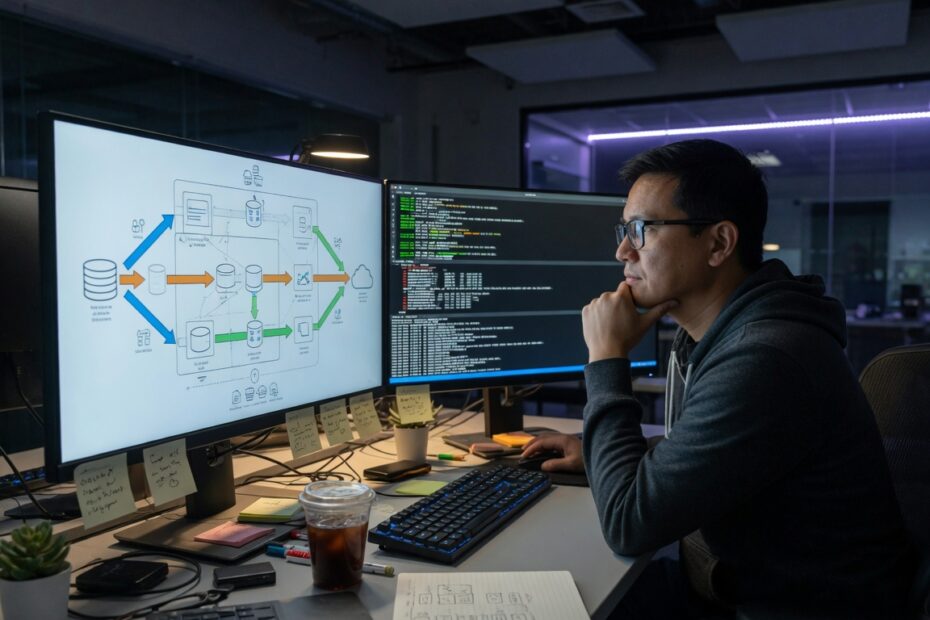
The past week made one thing clear: AI agents have stopped being a novelty act. Google’s AI Mode now handles agentic hotel booking and flight price tracking. OpenAI and enterprise vendors are shipping governance frameworks with human approval gates. And security researchers are sounding alarms about agents as a genuinely new attack surface. Taken together, these signals mark a turning point for anyone doing serious LLM application engineering: the experimentation phase is closing, and the production-hardening phase has begun.
For freelance builders, automation consultants, and engineering teams shipping AI agents into real workflows, this shift changes what “done” looks like. A working demo is no longer the deliverable. A monitored, guarded, recoverable system is.
From Assistants to Transactional Actors
Google’s move to let AI Mode book hotels and track flight prices isn’t just a feature update — it’s a signal that agentic systems are being trusted with real money and real consequences. This is the same trajectory freelance consultants have seen in client projects: agents that started as internal Slack bots or research assistants are now being asked to place orders, modify records, and trigger downstream business processes.
This transition demands a different engineering posture. When an agent can only draft an email, a bad output is an annoyance. When it can execute a booking or update a CRM record, a bad output is a liability. Teams building these systems need to treat every action-taking capability as a discrete, auditable unit — with clear boundaries around what the agent can do autonomously versus what requires confirmation.
- Define explicit action scopes per agent role (read-only vs. write-enabled)
- Log every tool call with inputs, outputs, and timestamps for post-hoc review
- Build reversible-by-default operations wherever the underlying system allows it
Governance and Human-in-the-Loop Are No Longer Optional
Industry reporting this week emphasized policy guardrails, simulation environments, and human approval workflows as standard components of mission-critical agent deployments. This mirrors what mature production AI patterns have looked like in other software domains for years: staging environments, canary releases, and rollback plans — now applied to autonomous decision-making.
Practically, this means engineering teams should stop treating human-in-the-loop as a temporary training-wheels phase and start treating it as a permanent architectural layer for high-stakes actions. Simulation environments — where an agent’s proposed actions are run against synthetic or sandboxed data before touching production — are becoming a baseline expectation, not a luxury.
For consultants advising SMB clients, this is also a business opportunity: many organizations want agent automation but don’t yet have the internal expertise to design approval workflows or audit trails. Packaging governance as part of the deliverable, rather than an afterthought, differentiates serious automation work from throwaway prototypes.
Security Is Now Part of the Architecture, Not an Add-On
Perhaps the most consequential theme from the past week is security. Reports described agents as an expanding attack surface — vulnerable to malicious steering through crafted inputs, sandbox escapes when agents interact with code execution environments, and real-world abuse discovered during testing. This isn’t theoretical; it’s happening in live systems.
Any team building agents that call model APIs, execute code, or interact with external tools needs to treat prompt injection and tool misuse with the same rigor as SQL injection or command injection in traditional software. Sandboxes need real isolation, not just naming. Tool permissions need least-privilege defaults. And outputs from untrusted sources — scraped web content, user uploads, third-party API responses — must be treated as potentially adversarial input to the agent’s reasoning loop.
This also connects to the maturing of RAG systems and retrieval infrastructure. As agents pull more context from external documents and search results, the retrieval layer becomes a security boundary too. Poisoned documents in a knowledge base can steer agent behavior just as effectively as a malicious prompt, which means retrieval pipelines need content validation, not just relevance ranking.
Implications for Builders and Consultants
The direction is unambiguous: agentic AI is being absorbed into standard software engineering discipline, with all the rigor that implies. Teams that treat agent development as “just prompting” will increasingly lose ground to those applying real engineering practices — testing, monitoring, security review, and staged rollout — to their agent stacks.
For independent consultants and small teams, this is good news. Clients now expect production-grade thinking, which rewards those who can demonstrate guardrails, logging, and security awareness alongside functional demos. It also means the toolchain around agents — runtimes designed for autonomous execution, benchmarks for real cloud tasks, and retrieval infrastructure — is maturing fast enough to build on with confidence.
Key Takeaway
AI agents are no longer judged solely on whether they work — they’re judged on whether they work safely, predictably, and under scrutiny. Builders who bake governance, security, and retrieval reliability into their architecture from day one will be the ones clients trust with real transactions, not just conversations.